
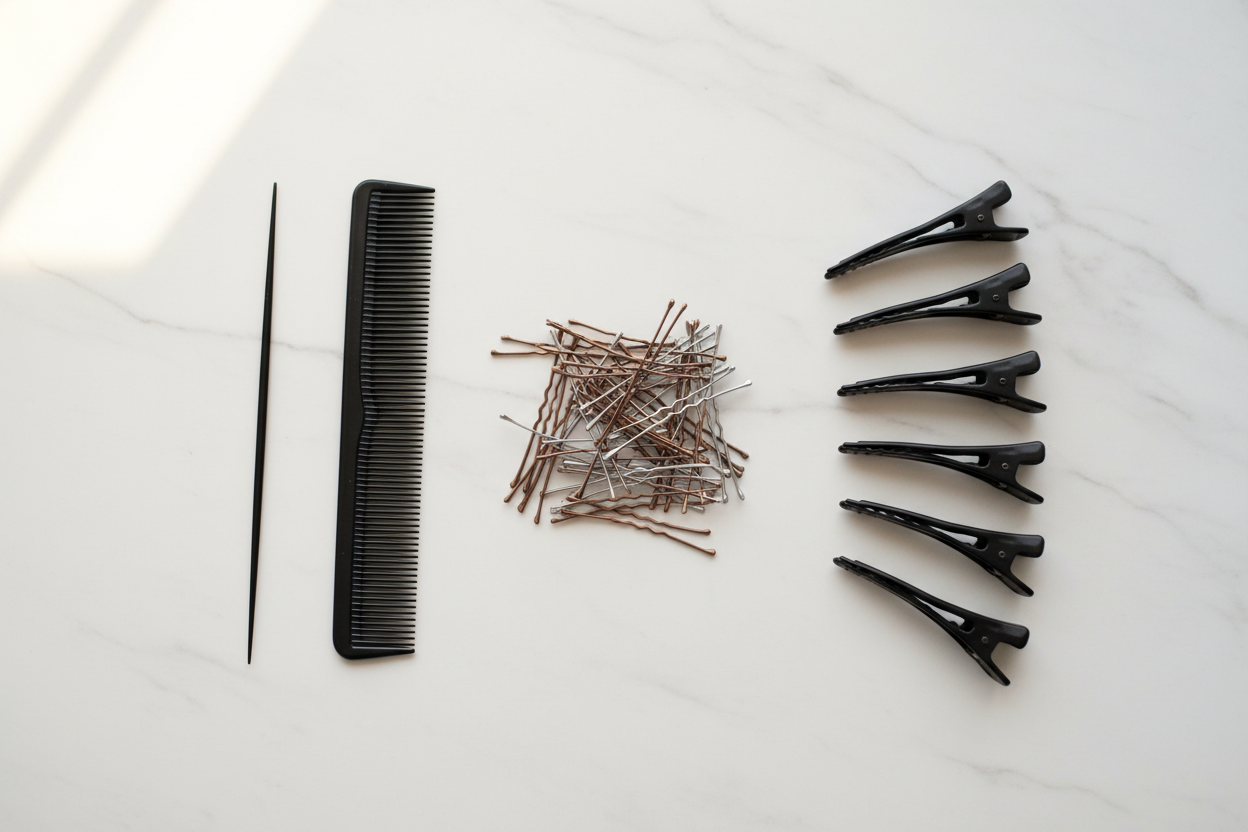
When you're first building a professional hairstyling kit, the number of different pins, combs and brushes available can be surprisingly confusing.
Bobby pins, U-pins, hair pins, rat-tail combs — they can all look relatively simple, but each one serves a different purpose. When I teach bridal hairstyling, I want students to understand not only what tool to use, but why they're choosing it.
Here are six essentials I recommend understanding when you're starting to build your professional hairstyling kit.
1. Bobby Pins & Hair Pins
Bobby pins and hair pins are some of the most important structural tools in your kit.
You'll use them to secure larger sections of hair, attach buns and help hold the overall structure of a hairstyle in place. Bobby pins tend to be easier for beginners to handle, while professional hair pins can offer a very secure hold once you become comfortable working with them.
One of the things new hairstylists gradually learn is that pinning isn't simply about putting more and more pins into the hair. Where you place the pin and what you're anchoring it to matters. A few well-placed pins can often give you much better security than using many pins without understanding the structure underneath.
2. U-Pins
U-pins have a very different job.
Rather than being your main structural pin, they're useful for more delicate work — shaping, tucking and controlling smaller sections of hair. For example, you might use a U-pin to refine the shape of an airy bun, tuck away a small strand or hold part of a soft hairstyle in place without flattening it.
They can also be useful when working with bridal veils and accessories. Once you understand the difference between structural pinning and decorative pinning, choosing the right pin becomes much easier.
3. Small Hair Elastics
Small black, brown or clear elastics are essential in a professional kit.
They're useful for securing ponytails, creating sections and building hidden structures underneath more complicated hairstyles. Because they're small and relatively discreet, you can often hide them within the finished hairstyle. A secure bridal hairstyle often has much more going on underneath it than the client ever sees.
Elastics, pins and carefully created anchor points form the structure that allows the finished hairstyle to look soft while still remaining secure.
4. Rat-Tail Comb
This is probably one of the combs you'll reach for most often.
A rat-tail comb has a long, narrow pointed handle that allows you to create clean sections and pick up very small areas of hair precisely. The comb itself can then be used for smoothing, teasing and controlling those sections. For bridal hairstyling, clean sectioning makes an enormous difference. If your sections are messy at the beginning, creating a polished finished hairstyle becomes much more difficult.
You can also find teasing or backcombing versions of rat-tail combs, which can be useful when you're trying to create controlled volume.
5. Round Brush
A round brush is particularly useful when you're preparing hair with a hairdryer.
By using tension, heat and the shape of the brush, you can smooth the hair, create movement and build volume — particularly around the crown. Different brush diameters will create different results. A larger round brush generally creates softer movement and volume, while a smaller brush gives you more control over shorter sections.
The important thing isn't simply owning a round brush. It's learning how to control the tension, direction and heat while you're using it.
Those are the things that actually create the result.
6. Paddle Brush
A paddle brush is one of the simplest tools in your kit, but you'll use it constantly.
It's useful for detangling and brushing through the hair before you begin styling. Starting with properly brushed and prepared hair makes your sectioning cleaner and allows you to assess the hair you're actually working with.
Depending on your preference, a detangling brush can perform a similar role.
Your Tools Are Only as Good as Your Technique
When you're starting out, it's very easy to believe that becoming a better hairstylist means buying more equipment.
But having twenty different types of pins doesn't automatically make a hairstyle more secure.
What matters is understanding what each tool does and when to use it.
- Why am I using a U-pin here instead of a bobby pin?
- Where is the structure of this bun actually being supported?
- Do I need more pins — or do I need a better anchor?
- Which comb will give me the control I need for this section?
Those decisions become more instinctive with practice.
And that's ultimately what professional hairstyling training should give you: not simply a list of tools and steps, but an understanding of how to use them.
At Bloom Pro Academy in Singapore, students learn professional hairstyling techniques hands-on, from hair preparation and sectioning through to bridal buns, braids, waves and complete hairstyles.
Our 64-Hour Bloom Pro Artist Course combines professional makeup and bridal hairstyling training, while students who want to specialise specifically in hair can also take our Professional Bridal Hairstyling Course.
Explore the Bloom Pro Artist Course →
Explore the Professional Bridal Hairstyling Course →
Roseanne
Bloom Pro Academy